Man in the Moon Drawing
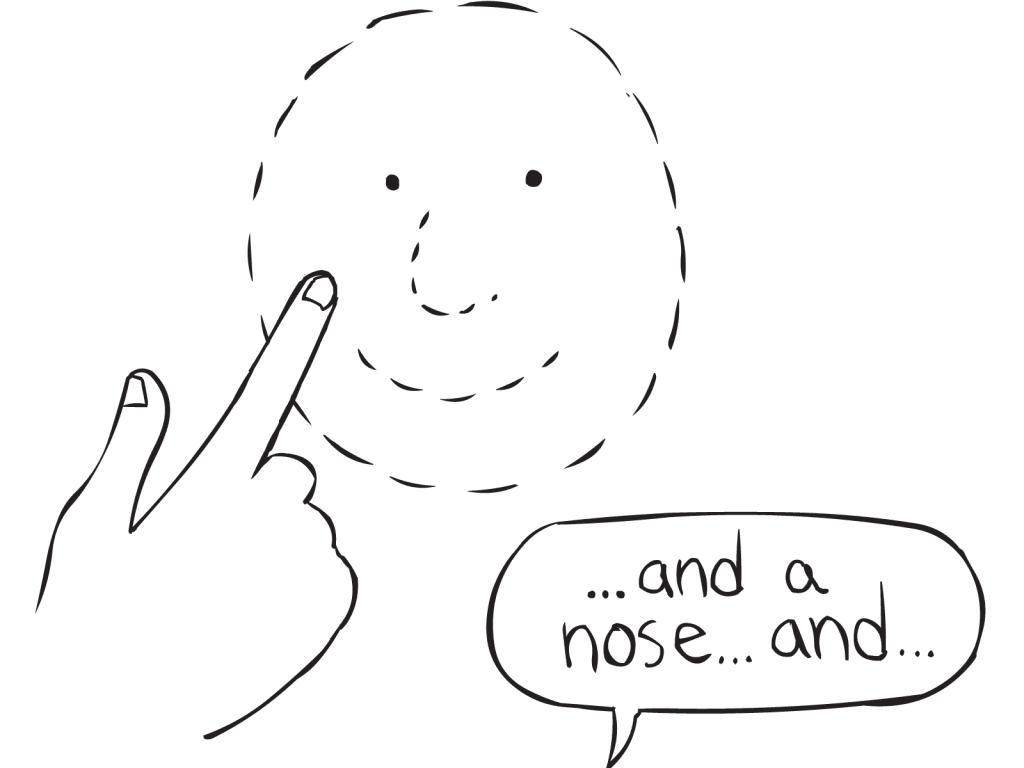
The Man In The Moon
Fun lateral-thinking exercise with a focus on subtlety.
- Simple, but not easy
- Develops critical thinking
- Promotes creativity
- Sharpens observation skills
- No props
Step-by-Step Instructions
- Sit in a circle, including yourself.
- Each person aims to identify what the 'key' is to unlock the secret to this puzzle.
- Use your index finger to draw a circle in the air in front of you, and then add two eyes, a nose and a mouth.
- As you draw, subtly clear your throat and say "THE MAN IN THE MOON HAS TWO EYES, A NOSE AND A MOUTH."
- Next, invite a series of volunteers to repeat exactly what you did.
- Here's the key: subtly clear your throat just before you start drawing.
- Unless a person clears their throat before commencing their attempt, they will not have unlocked the secret key.
- As each person makes an attempt to uncover the key, congratulate those who get it, and encourage those who do not.
- Continue to offer more and more obvious clues until everyone has identified the key.
Video Tutorial
Video Transcript for Man on The Moon
presented by Mark Collard
This is an exercise that you effectively will be doing on your own. That is to say that once you get it you could just as a choice you go… this is what he's doing. You could do that but you're actually going to disempower someone else's experience. So allow them to get it in their own time.
Here is my promise. In the next few minutes, next two, three, or four minutes, everyone in this room is going to know what's going on here. So if in the beginning you go I have no clue, don't worry, hang in there, because in a couple of minutes' time you will. And in fact I'm going to do it a couple of times.
So to begin, I happen to have in my hand a drawing instrument. And so what I plan to do is actually draw the man in the moon. Okay. So immediately that is a sensitivity for some people, so beware that it's something that you want to actually notice. So I want you to be able to do this for yourself.
So it begins. The man on the moon has a big face, two eyes, a nose, and a mouth. I'll do it again just to be very sure that you got it, because in a moment I'm going to ask for volunteers to actually share exactly what I did with the rest of the group. Again if you know it, great. In a few minutes everyone's going to know how to do this.
To begin, the man on the moon has a big face, two eyes, a nose, and a mouth. For those particular who rolled their eyes a moment ago and thought oh, I know where this is going, would you like to have a go? And do it in a way that everyone else can see what… so that we can actually see and hear you. Who would like to give this a go? Who would like to show how to draw the man in the moon?
(I'm in.)
You've got it.
(The man in the moon has a big face, two eyes, a nose, and a mouth.)
Terrific, but not it. But thank you for playing. Okay. That's great. So it takes one person to give it a go. So fantastic. So not quite. Something is not quite right. Sorry, I thought I saw another hand. Who would like to give it a go? If not would you like me to show it to you again?
Fantastic. Okay, because you want to do it exactly the same way, what I am doing. The man on the moon has a big face, two eyes, a nose, and a mouth. Who would like to do that? Yes, you got it.
(The man in the moon has one eye, two noses, and a huge mouth.)
No. No. That's okay. Beth.
(The man on the moon has a big round face with two eyes, a nose, and a mouth.)
Beautiful. Exquisite. Exactly as I did it. Sally.
(The man in the moon has a big face, two eyes, a nose, and a mouth.)
Terrific. Remembering at this point if you don't have it, don't worry. In a couple of minutes you will because shortly I'm going to ask those who have got it to help me provide some clues.
(The man on the moon has two eyes, a nose, and a mouth.)
Beautiful. Nice. Go ahead.
(The man on the moon has two eyes, a nose, and a mouth.)
Okay, anyone else would like to have a go? Yes.
(The man on the moon has a big face, two eyes, a nose, and a mouth.)
Nice. Subtle, but nice. Very good. Very good. I almost missed that myself. Would you like to have another go?
(Yeah. The man on the moon has a big mouth, two eyes, a nose, and a mouth.)
Beautiful. Alright, we're going to start giving some clues now. So if you're in the world of "I have no clue what's going on", that's okay. That's exactly where you're supposed to be right now.
So for example, the man on the moon has a big face, two eyes, a nose, and a mouth. Who would like to have a go? Yeah.
(The man in the moon has a big face, two eyes, a nose, and a mouth.)
Nice. Very good. Yeah, got it. Fantastic. For all… Hands up those folks who have got a theory and it's working for you at this stage. Fantastic.
Together on the count of three, without giving too much away but we're going to do it perfectly, we're going to draw together the man in the moon. Are you ready? On the count of three. One. Two. Three. The man on the moon has two eyes, a nose, and a mouth.
Okay. Who would like to have a go now that perhaps hasn't until this point got it?
(murmurs)
If you don't have it but… do you have it now? Not yet? That's okay. Hang in there. In another minute you're going to have it. Okay, go ahead.
(Can I give it a go?)
Yes, sure.
(The man on the moon has two eyes, a nose, and a mouth.)
So close. I don't think it was it. I couldn't quite tell but I don't think so. Yeah, Tim.
(The man on the moon has a big face, two eyes, a nose, and a mouth.)
Subtle but you got it, yes. Fantastic. Alright, together all those that have it… You're about a minute away folks if you don't. On the count of three and we can make it a lot more obvious now. One. Two. Three. The man on the moon has two eyes, a nose, and a mouth.
Okay. Is anyone unclear as to what the key is? It's okay to say you still haven't got it.
(I'm just so angry.)
(Do you have it?)
(No, I've got it now.)
You've got it now. Alright, so let's just be clear what was the key? Clearing the throat. Now in some cases it was very subtle. In the beginning you didn't see or hear it at all. It was always there.
(I thought it was your arm at first.)
Excuse me?
(I thought it was your arm at first.)
Good. So I do ask that question, so what theories were you working with because you knew it had less to do with this thing that I was drawing in the air and had something else to do. Right.
What other theories do people have trying to identify the key?
(I thought it was the way you crossed your legs.)
Right, yes. Little Indian style thing. But yes… I've noticed you've crossed it the same way. It's great but for another exercise it could. Very good. What else? What were the other keys you were trying to unravel?
(The first two times you said "to begin," so I thought 'ah!')
Terrific. Excellent. Sometimes it'll get to the point where it'll be a bit like someone else had done, it was like four eyes, sixteen mouths and it's like hang on, that's nothing like what you first did, giving a clue that it had nothing to do with that but it had something to do with something else. Any other theories people had?
How To Play Narrative
This game is just one of many dozens of lateral-thinking, What's The Key? type puzzles that invites your group to discover a 'secret key,' but is never quite as easy or as obvious as it appears. As they say 'truth is obvious to those who know it.'
Explain that each person's task is to identify the 'key' which unlocks the secret to a game, which in this case, involves drawing the mythical man in the moon.
Subtly, clear your throat to announce you're about to start, and then use your index finger to draw a circle in the air in front of you, and then add two eyes, a nose and a mouth. And, as you draw, say "THE MAN IN THE MOON HAS TWO EYES, A NOSE AND A MOUTH."
Invite several brave souls in your group to repeat exactly what you did. Invariably, they will get it wrong. There will be all manner of attempts, many gallant, but they will all be missing one vital ingredient…
Here's the key: the subtle clearing of your throat just before you start drawing.
So, it looks and sounds like this – with finger poised in the air, you clear your throat, and then launch into "THE MAN IN THE MOON HAS TWO EYES, A NOSE AND A MOUTH" as your finger glides through the air.
Unless a person clears their throat before commencing their recitation and drawing of the man in the moon, they will not have unlocked the secret key.
Provide gradual clues to allow those who have not got it to get it. I will always tell people that "…WITHIN FIVE MINUTES EVERYONE WILL HAVE IT, SO KEEP TRYING."
As each person has a go, congratulate those who get it, and encourage those who do not. That is, if a person does not clear their throat at the beginning, explain that they haven't got it… yet.
Expect lots of confused looks in the beginning, especially when your group believes that they are imitating your exact moves and words.
Sooner or later, one or two people will catch on to what's going on. At this point, start to offer more and more obvious clues, such as inviting the clued-in folk to draw at the same time as you – this often exacerbates the sound of the subtle cough.
Continue until everyone has unlocked the key.
Be sure to review the Leadership Tips tab to learn some useful tips to present this exercise thoughtfully.
Practical Leadership Tips
This is an ideal game to play to occupy your group when you're sitting around a camp-fire, or filling in idle time.
As a lateral-thinking exercise, this game is great for sparking a little creative and critical thinking in your group. People have to look beyond what is obvious and discover another truth. As you can imagine, the connections one can draw from the experience of looking for the 'key' to the real world are many. For example, I like to connect the fact that while the 'key' is very subtle, it impacts significantly on the solution, in much the same way that subtle glances and mannerisms in a training group or classroom can often have a significant impact on people's learning.
Please note, the point of lateral-thinking types of activities should not be to frustrate your group beyond enjoyment. They are designed to be fun, but don't play for more than 10 or 15 minutes. Gradually introduce more and more obvious clues so that, eventually, everyone gets the 'key.'
Ask your group to resist the urge to share the 'key' with others once they work it out. Assure everyone that they will ALL know the solution within, say, ten minutes, and it's more powerful to discover the solution on their own, than have someone tell them the answer. Besides, whispering the answer to a neighbour only reinforces the fact that they couldn't do it without help, and getting it will not change their lives.
That said, be aware that some people will reel at the very thought of trying to solve this sort of puzzle, because it involves 'lateral-thinking.' Often, these folk have had very negative experiences in the past with this sort of exercise, ie when the puzzle is worked on for hours, or perhaps the solution is never revealed. So, be prepared that some people will immediately 'check-out' of this exercise. To this end, note my comments below…
- Be very careful in your language. Note two important factors in the presentation I describe above:
– The task is to identify what the 'key' is, and to repeat exactly what I do. This exercise has nothing to do with drawing the air – rather, it seeks to sharpen observation skills and heighten awareness of subtlety.
– Everyone is aware that they will know the answer very soon. This is critical to maintain interest, lest some people (often those who never 'get' these sorts of puzzles) lose interest very quickly. - Do not present more than one or two of these types of puzzles in a row – seldom do the people who didn't get it the first time, get it the second time.
Social-Emotional Learning
You could integrate The Man In The Moon as part of a well-designed SEL program to develop your group's ability to manage their emotions, thoughts and behaviours effectively in different situations and to achieve goals.
Specifically, this activity offers ample opportunities to explore and practice the following social & interpersonal skills:
Self-Awareness
- Identifying Emotions
- Linking Feelings, Values & Thoughts
- Recognising Strengths, Prejudices & Biases
- Demonstrating Self-Confidence, Honesty & Integrity
- Experiencing Self-Efficacy
Self-Management
- Identifying & Managing Stress
- Demonstrating Self-Discipline & Self-Motivation
- Taking Initiative
- Use Planning & Organisational Skills
Social Awareness
- Demonstrating Empathy & Compassion
- Understanding & Expressing Gratitude
- Appreciating Diversity
- Recognising Strengths In Others
- Respecting Others
Relationship Skills
- Communicate & Listen Effectively
- Work Collaboratively
Responsible Decision-Making
- Demonstrating Curiosity & Open-Mindedness
- Identifying Problems
- Making Reasoned Judgements
- Identifying Solutions
- Anticipating & Evaluating the Consequences of One's Actions
- Promoting Personal & Collective Well-Being
You can learn more about SEL and how it can support character education here.
Health & Wellness Programming
There is no specific health & wellness perspective to this activity other than promoting the benefits to one's wellbeing of solving a cognitive challenge and perhaps, enjoying a good laugh.
In a small way, you could argue that the focus required to successfully crack the code may speak to the benefits of being mindful because identifying a solution requires singular attention to one thing at a time. There is also no doubt that one must apply a generous dose of resilience to solve this task as well, so it is ideal for integrating into any program that explores strategies for building this critical wellbeing skill.
Note also the recommendations for how you present this lateral-thinking exercise in the Leadership Tips tab to support the emotional and mental wellbeing of your group. If presented thoughtfully and as part of an appropriate sequence, it is highly likely that even those people who do not (traditionally) like these types of games may enjoy themselves.
If you can think of more explicit ways in which The Man In The Moon could be purposefully integrated into a health and wellness program, please leave a comment at the base of this page.
Popular Variations
- New Key: Vary the key, eg interlock your fingers in front of you as soon as you have finished drawing.
- More What's The Key? Puzzles: Bang, You're Dead, Black Magic, Come To My Party, Crossed or Uncrossed, Dead Or Alive?, Johnny Oops and Magic Nine Numbers.
- Subtle Trust: While not a lateral-thinking exercise, take a look at The Rock to explore a powerful, trust-building experience that focuses on subtlety.
- Open the Virtual Adaptation tab to learn how to present this activity online
Virtual Adaptation
- In the beginning, ask your group to switch to Speaker View to focus on you and your behaviours, and then as more and more people 'get' the key, encourage them to switch back to Gallery View to observe others.
- Ensure that it is possible for your (remote) group to see and hear everything about your key. For example, if the key involves resting your interlocked fingers in your lap at the end, it is critical that your group will be able to witness this occurring.
- When you invite individual group members to attempt to crack the code, switch on their microphone.
You Might Also Like...
Stick Around
Hilarious small group initiative to inspire creativity.

Wordles
Series of fun & clever cryptic word puzzles to solve.
Birthday Numbers
Unique mathematical puzzle to challenge small teams.
Useful Framing Ideas
This next game was presented to me many years ago around a camp fire, and it immediately piqued my interest. It took me a while to work it out, let's see how long it will take you…
Have you ever had the experience of not seeing something until it was pointed out to you? And then, you could not imagine how you missed it in the first place. I do this all the time, especially with my car keys – I can be staring at them, and still not see them. Well, this next exercise is a little bit like that…
Reflection Tips & Strategies
Coupled with one or more reflection strategies, here are some sample questions you could use to process your group's experience after playing this intriguing lateral-thinking exercise:
- Did it take you long to figure out what the key was?
- How did you feel during the exercise, especially when you finally unlocked the key?
- What did you notice among other members of the group who had not unlocked the key?
- What did these behaviours communicate to you?
Source

No Props No Problem
Brand NEW book featuring 150+ outrageously fun group games & activities. Scan QR codes to connect to tons of digital content including video tutorials.
Add to Cart
Source: https://www.playmeo.com/activities/fun-large-group-games/the-man-in-the-moon/
0 Response to "Man in the Moon Drawing"
Post a Comment